P/01Legged Robotics
Quadruped Platform
Full-size quadruped for locomotion, perception, and IoT-connected operation in human-centered environments.
I'm Dr. Akin Tatoglu, Professor of Mechanical Engineering and Associate Dean of the College of Engineering, Technology and Architecture (CETA) at the University of Hartford. I direct the ARAI Lab, where we build robots and AI systems for defense, healthcare, agriculture, and education, and carry them from the lab into industry-ready systems.
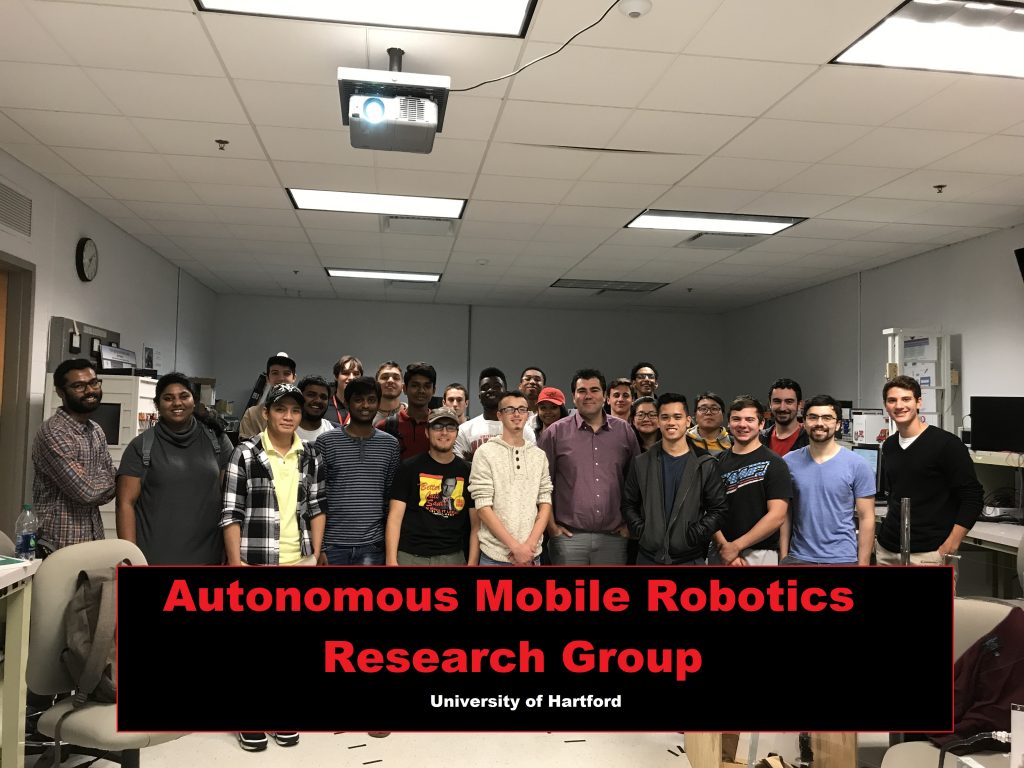
I direct the Autonomous Robots and AI (ARAI) Lab, which I founded in 2015 as the Autonomous Mobile Robotics (AMR) Research Group. The lab is a team of 8–12 undergraduate and graduate engineers working on legged robots, autonomous vehicles, 3D perception, medical imaging, and edge AI. I source the lab's projects myself and run them end to end with industry, clinical, and academic partners.
I've published more than 40 peer-reviewed papers at venues including IEEE ICRA, ASME IMECE, SPIE, FLAIRS, ASEE, Inter-Noise and the Acoustical Society of America, and in journals including the Journal of Intelligent & Robotic Systems and Applied Acoustics. Since 2015 the lab has led ten externally funded projects, most with me as PI, with support from NASA, the DoD SBIR program, the State of Connecticut, and industry.
Before academia I spent six years in industry R&D, leading software and engineering teams at Tumer Engineering (METU Technopolis, Ankara) and Underwater Systems Inc. (California). I've been building companies since 1999.
Active projects with student, clinical, and industry teams.
Full-size quadruped for locomotion, perception, and IoT-connected operation in human-centered environments.
Outdoor autonomous vehicle platform for navigation, mapping, and sensor-fusion research.
Segmentation pipeline that turns CT scans into 3D-printed rib twins for preoperative surgical planning, with Hartford Hospital.
3D reconstruction, AI/ML defect detection, and instrumentation for a manufacturer's test rig (sponsored).
Benchmarking lightweight, fully offline generative AI on NVIDIA Jetson hardware for mobile-robot control and voice interaction.
Rapid 3D map generation from aerial vehicles to find safe landing zones, with field testing by an industry partner.
Soft robotic actuators that sense force indirectly, without dedicated force sensors, so soft grippers and joints can feel what they touch.
UWB radar and audio-visual methods that let mobile robots detect motion and sound sources around corners and through walls.
Full CV and papers available on request.
The ARAI Lab is 8–12 engineers at any time, full- and part-time, undergraduate and graduate, from mechanical, electrical, computer, and biomedical engineering. Students run full project cycles from design to field test, co-author papers, and go on to robotics and aerospace roles in industry. More than 30 students have co-authored peer-reviewed work from the lab. The team meets weekly, runs hands-on workshops, and for the past eight years has hosted an annual Robotics Colloquium where students present their work.
Undergraduate and graduate students from any engineering or computing major are welcome. We meet weekly during the semester, and new members start on an active project. Email with your major, year, and what you want to build.
tatoglu@hartford.eduIndependent technical and financial counsel for boards, founders and investors in robotics, AI and deep tech. Two decades building autonomous systems, 40+ peer-reviewed papers, and a co-founder seat at a venture-backed hardware company, paired with an MBA. I read the hardware, the code and the financial model, and tell you which claims hold.
Start a conversationAn independent technical voice in the boardroom. I review the roadmap, architecture and engineering risks, and I tell the board plainly which claims are proven and which still need testing.
Before you invest, I check the pitch against the product. That covers the technology, the IP, the team's ability to deliver, and the competitors already in the market. You get a written assessment that separates what's demonstrated from what's promised.
I build revenue, unit-economics and cash-flow models around how hardware and deep-tech companies actually grow: field deployments, fleet ramps, consumables and recurring revenue. They're built for fundraising and board planning, with every assumption visible and editable.
They give directors an independent read on the technology: whether the roadmap is realistic, where the engineering risks are, and which milestones are proven.
The technology's maturity, IP position, team capability, competitors, and how the company's claims compare with the evidence.
Robotics, autonomous systems, edge AI, sensing and IoT, agtech, and hardware-plus-software products.
I work with companies that need autonomy without the multi-year overhead, from early-stage startups to established manufacturers.
Sponsored research, joint prototypes, and applied autonomy work built around your operational constraints.
License lab-grown IP in perception, 3D mapping, sensor packaging, and custom locomotion for your product roadmap.
Recruit from a pipeline of robotics-trained engineers, or bring me in as a technical advisor to your board on autonomy and AI strategy.
See advising servicesDrop a line about your project, problem, or partnership idea. I respond personally within a few days.
tatoglu@hartford.edu